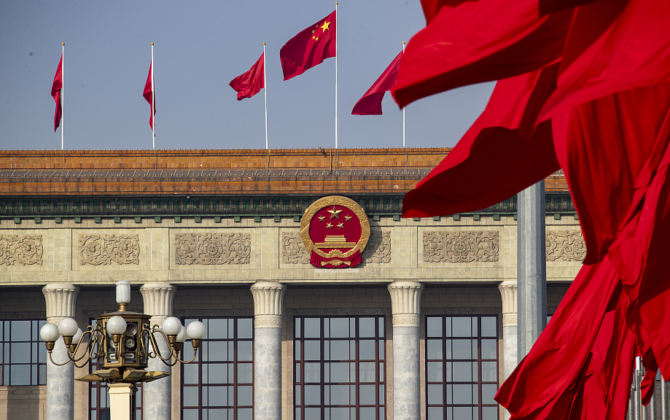
(AFP) – At least 250 journalists are jailed around the world, with the largest number held in China, amid a growing crackdown by authoritarian regimes on independent media, a press watchdog group said Wednesday. Many of those imprisoned face “anti-state” charges or are accused of producing “false news,” according to the report by the New York-based Committee to Protect Journalists which also cited Turkey, Saudi Arabia, Egypt, Eritrea, Vietnam, and Iran for their jailing of journalists. The press freedom watchdog said it counted at least 48 journalists jailed in China, one more than in 2018, as President Xi Jinping ramps up efforts to control the media. That put China ahead of Turkey, which has 47 imprisoned journalists — and the largest number over the previous three years. But Beijing defended its press freedoms on Wednesday and said the Chinese government was simply carrying out the rule of law. “No one is above the law,” said foreign ministry spokeswoman Hua Chunying at a press briefing, before advising reporters to consider what “illegal things” the 48 jailed journalists did.
The report also said the situation in Turkey, which had 68 journalists jailed last year, is not really an improvement but “reflects the successful efforts by the government of President Recep Tayyip Erdogan to stamp out independent reporting and criticism.” The CPJ said the Turkish government has shut down more than 100 news outlets and lodged terror-related charges against many of their staff, putting many reporters out of work and intimidating others. “Dozens of journalists not currently jailed in Turkey are still facing trial or appeal and could yet be sentenced to prison, while others have been sentenced in absentia and face arrest if they return to the country,” the committee said. The report said authoritarianism, instability and protests in the Middle East led to a rise in the number of journalists locked up in the region, with Saudi Arabia on a par with Egypt as the third worst jailer worldwide, each with 26 imprisoned. In Saudi Arabia, no charges have been disclosed against 18 of the journalists behind bars, and CPJ expressed concern over reports of “beating, burning and starving political prisoners, including four journalists.”
Several of the arrests in Egypt came ahead of protests against corruption in September, which included calls for President Abdel Fattah el-Sisi to resign. – ‘False news’ arrests – Campaigners say the global total of 250 remains disturbingly high even if it is slightly below the 255 counted in 2018 and the record 273 in 2016. “CPJ believes that journalists should not be imprisoned for doing their jobs,” the group said in its report. It cited the case of Chinese freelance journalist Sophia Huang Xueqin, arrested in October after writing about marching with pro-democracy protesters in Hong Kong. It also highlighted the case Egyptian economics reporter Mohammad Mosaed, detained after tweeting during an internet shutdown intended to suppress news of protests against high fuel prices. Globally, the number charged with “false news” rose to 30 compared with 28 last year. This charge is used most frequently in Egypt but has also been leveled against journalists in Russia and Singapore. HONG KONG, (AFP) – An international panel of experts hired to advise Hong Kong on the police response to huge pro-democracy protests announced Wednesday they were quitting,
saying the watchdog was not fit for purpose “in a society that values freedoms and rights”. The group’s damning conclusion is a blow to Hong Kong’s government, which has insisted its Independent Police Complaints Commission is capable of holding the force to account over snowballing claims of brutality. “We ultimately concluded that a crucial shortfall was evident in the powers, capacity and independent investigative capability of IPCC,” the experts said. Critics have long charged the body lacks adequate powers, is stacked with pro-establishment figures and has been toothless when it comes to keeping the police in line. The watchdog can only handle complaints forwarded by the police themselves and it cannot subpoena documents or compel witnesses to testify. Such limitations, the expert panel said, do not “begin to meet the standards citizens of Hong Kong would likely require of a police watchdog operating in a society that values freedoms and rights”.
Protests have rocked Hong Kong for more than six months, with up to two million people taking to the streets, initially against a now-shelved extradition bill. Latterly, one of the core demands of protesters — alongside fully free elections — has been an inquiry into the police, who have been left to battle increasingly violent black-clad activists and are now loathed by significant chunks of the deeply polarised population. But both chief executive Carrie Lam and the police have repeatedly rejected those calls. Pro-democracy lawmaker Tanya Chan described the resignation of the expert group as a “vote of no confidence” in the IPCC and the interim report it is expected to produce next year. Political scientist Ma Ngok said the panel’s decision confirmed Hong Kong people’s doubts on the IPCC’s ability to find the truth.”The government’s strategy of making the report independent by having a panel of overseas experts has failed,” Ngok told AFP. – Public row – The panel was announced in September and was chaired by Sir Dennis O’Connor, who was tasked by the British government to write a report on the police after the 2011 London riots.
It included current or former police watchdog chiefs from Canada, Australia and New Zealand, and a British specialist on crowd behaviour. A month ago, a leaked statement from the group revealed they felt the police watchdog was not equipped to carry out a proper investigation, and suggested a fully independent inquiry would be better suited.But their frank assessment was not welcomed by Anthony Neoh, the IPCC’s head. He gave an interview to a mainland Chinese media outlet rebuking the panel, saying they “do not understand Hong Kong’s situation”. On Sunday, an estimated 800,000 people marched peacefully through the city’s streets in a movement that has become a popular revolt against Beijing’s authoritarian rule. The last three weeks have seen a rare lull in the violence and vandalism after pro-democracy parties won a landslide in local council elections.”Do not waste time, and please grab this golden opportunity to persuade Beijing… to support an independent commission of inquiry,” lawmaker Chan added. An end to violence is something Lam has insisted must be a precursor to meaningful dialogue.But she has shown no sign she is willing to budge, leading to fears clashes could resume.
In her weekly press conference on Tuesday she dismissed protesters’ demands once more as she announced plans to go to Beijing this weekend where she is expected to meet with Chinese leader Xi Jinping.China has publicly thrown its support behind both Lam and the city’s police, even as their approval ratings take a hammering.